


 Xcite Auto
What Frontline Ready Means in 2026
 Xcite Auto : Nov 26, 2025, 9:06:05 AM
The phrase “frontline ready” is nothing new in the dealership world. Most GMs, used-car directors, and internet managers use it every day. But in...
Most dealership leaders spend a lot of time thinking about inventory, pricing, turn rates, and lead volume. Few spend much time worrying about image compliance. Until a problem surfaces.
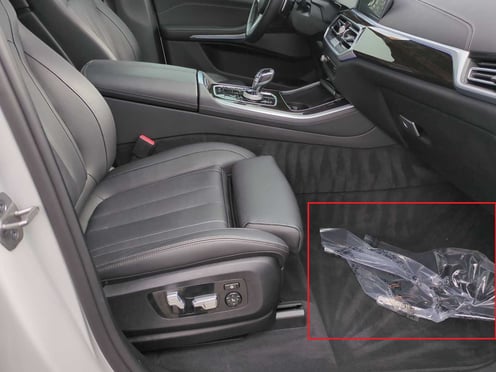
A photographer’s shadow on a vehicle. A competitor’s sign in the background. A paper floor mat left in the footwell. A vehicle is photographed in the wrong sequence for an OEM program. A banner or overlay gets applied incorrectly.
For OEMs and dealership groups managing thousands of vehicle listings across rooftops, small inconsistencies quickly become large problems.
That reality is just one reason image compliance has become a growing focus across the automotive industry.
Every Vehicle Listing Represents the Brand
The average shopper doesn’t separate the vehicle from the dealership or the dealership from the OEM. If images on a listing look professional, consistent, and trustworthy, that perception extends to the dealership. If the images look sloppy, cluttered, or inconsistent, the opposite happens.
Manufacturers spend billions building brand equity. They carefully define how vehicles should be presented, what angles should be used, how backgrounds should appear, and what elements should be avoided. Yet once vehicles reach dealer inventory, maintaining those standards across thousands of listings becomes extremely difficult.
That is why image compliance has evolved from a marketing concern into an operational one.
Non-Compliant Image Examples
When people hear the word compliance, they often imagine legal disclosures or financial regulations. In vehicle merchandising, compliance has a direct impact on merchandising and sales. Common issues include:
Competitor branding visible in the image
Window stickers obscuring key features
Poor image sequencing
Unauthorized banners or overlays
Dirty surfaces or visible debris
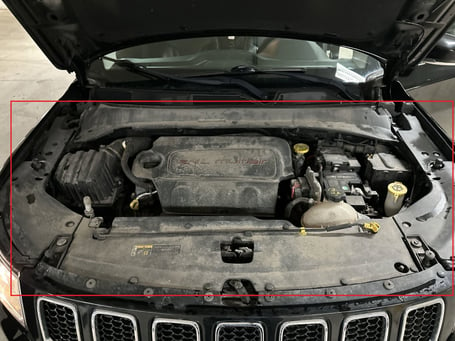
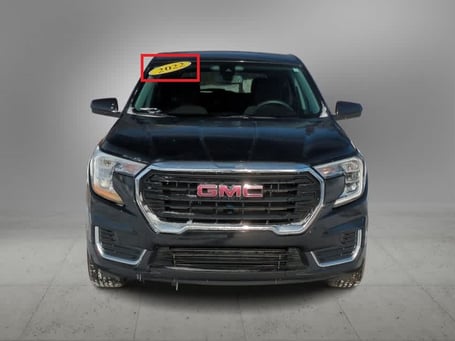 Examples of non-compliant vehicle images flagged by Automated Compliance include a dirty engine and a sticker on the car window.
Research across retail and e-commerce consistently shows that visual consistency influences buyer confidence and purchasing behavior. Poor or non-compliant imagery can reduce trust and create friction during the evaluation process. Car shoppers are no different.
The Challenge of Scale
Most dealerships already know what good vehicle photography looks like. A single rooftop may publish hundreds or even thousands of vehicle images each month. Dealer groups can be managing tens of thousands of images across multiple locations. OEM programs may involve millions.
Historically, the only way to monitor compliance was through manual review. Marketing teams would spot-check listings. Managers would occasionally review inventory. OEM field teams might audit samples.
The problem is that manual review rarely catches everything. And it takes a lot of time. That's a recipe for error and inefficiency. At scale, even well-run organizations struggle to review every image.
Compliance and Trust Are Closely Related
One of the most interesting aspects of image compliance is that its value extends beyond satisfying OEM requirements.
It directly affects shopper trust. Consider two vehicle listings.
The first contains inconsistent angles, distracting backgrounds, visible clutter, and illogical image sequencing. The second follows a consistent process and presents the vehicle clearly and professionally. Even if both vehicles are identical, shoppers perceive the second listing as more credible.
This is because visual consistency communicates professionalism. It suggests attention to detail. It signals that the dealership takes presentation seriously. You can see how compliance becomes a proxy for trust.
Practical Steps Your Dealership Can Take Today
The good news is that dealerships don’t need advanced technology or elaborate processes to improve image compliance.
The most successful stores start by creating clear capture standards. Every vehicle should:
follow the same shot sequence
use the same required angles
adhere to the same visual standards
Quality control is equally important. Images should be reviewed before they go live whenever possible. Be sure to catch common issues such as:
blur
glare
obstructions
Dealerships should also pay attention to their shooting environment. Consistent backgrounds and staging areas help create a more professional appearance and reduce the likelihood of compliance issues.
Finally, teams should resist the temptation to overcorrect through editing. Buyers need to see the real vehicle, not a digitally altered version of it. Enhancing image quality is one thing; creating unrealistic representations is another. Trust is must easier to lose than it is to regain.
Where the Industry Is Headed
The automotive industry is already moving toward greater standardization of vehicle presentation. OEMs want consistent branding. Dealer groups want consistent quality. Shoppers want consistent experiences.
Technology is helping bridge that gap by making it possible to review far more images than humans alone could reasonably inspect. Tools can now identify image sequencing issues, unauthorized branding, reflections, clutter, and other quality concerns at a scale that was previously impossible.
The goal is to create vehicle listings that build confidence, reinforce brand standards, and help shoppers make decisions more comfortably.
If you have questions about image compliance, get in touch with our team of experts today. We're here to help.
Xcite Auto : Nov 26, 2025, 9:06:05 AM
The phrase “frontline ready” is nothing new in the dealership world. Most GMs, used-car directors, and internet managers use it every day. But in...
Xcite Auto : Oct 1, 2025, 12:41:29 PM
Think back to the last time you clicked on a listing for a new car. Did it feature generic stock imagery, or did you get pictures of the exact...
Xcite Auto : Sep 3, 2025, 12:08:20 PM
Auto dealerships don’t sell cars; they sell first impressions. Car shoppers' first impressions happen online. In today’s car-buying journey, vehicle...
.png)
Xcite Auto : Dec 23, 2025, 12:30:41 PM
Every year, NADA brings the auto industry together to talk about what’s next. New tools, new ideas, new promises.
.jpg)
Xcite Auto : Mar 26, 2026, 11:00:45 AM
You know the rule: Don’t let perfect be the enemy of good. How does this rule work with vehicle merchandising in the age of AI? Every dealership has...
Xcite Automotive Will Provide GM Dealers with On-the-Lot, Standardized Vehicle Imagery Services